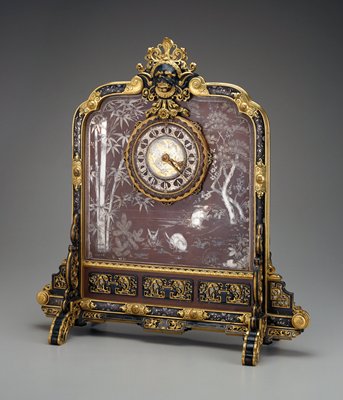
Clock
- Medium
- Silver, bronze, copper, gilt, pigment
- Dimensions
- 20 1/2 x 19 1/2 x 7 3/4 in. (52.07 x 49.53 x 19.69 cm) 6 1/2 x 2 3/8 x 7/8 in. (16.51 x 6.03 x 2.22 cm) (pendulum)
- Genre
- Horology
Tags
france
About
This magnificent clock illustrates some of the earliest Japanese influences on European decorative arts following the reopening of Japan to the Western world in 1854. The clock combines European and Asian iinfluences. Its overall form is derived from an 18th-century Chinese table screen; the face and whimsical beast above it is inspired by Tibetan mandalas; and the silver inlay depicts scenes taken from Japanese paintings, lacquerware, and ceramics. Reiber had tremendous interest in Japanese motifs and he imitated Japanese mixed metal and cloisonné work. He spent hours copying Chinese bronzes and Japanese decorative arts for Christofle, the foremost French firm of silverplating and metalwork during the second half of the 19th century.