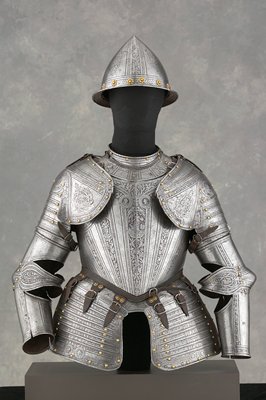
Half armor
Italy
1570
- Medium
- Steel, leather, cloth
- Dimensions
- 11 1/4 x 13 x 9
- Genre
- Arms and armor
Tags
Italy
About
Infantry soldiers, who valued full mobility over leg protection, commonly wore half armors of this type. An elaborately etched armor such as this was probably commissioned by an officer to display his social rank and status. The etching technique involves applying a resist agent such as wax or varnish to the polished steel, then dipping it in acid to etch away the unprotected background. Originally developed to decorate armor, etching was later adapted for printmaking. The decorative scheme combines military, Christian, and classical themes. Bands of stylized military trophies of arms form a background for medallions framing classical heroes and biblical characters. The breastplate medallion features the biblical heroine Judith, who saved her city from the Assyrians by seducing their general, Holofernes. When Holofernes fell into a drunken stupor Judith cut off his head and displayed it at the city gate. The Assyrians awoke confused and leaderless and were easily defeated by Judith's people.