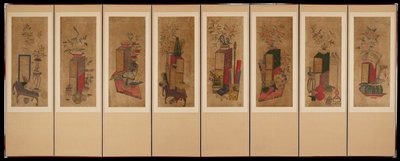
Books and Scholar’s Objects (Chaekgeori)
- Medium
- Eight-panel folding screen, ink and color on paper
- Dimensions
- 68 1/4 x 172 x 5/8 in. (173.36 x 436.88 x 1.59 cm)
- Genre
- Paintings
Tags
Korea
About
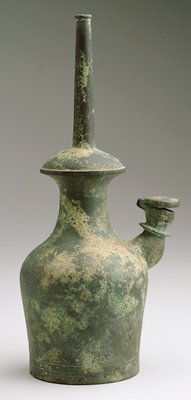
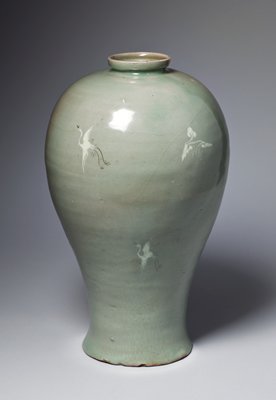
In the late 1700s in Korea, folding screens depicting books and other objects related to scholarly pursuits became popular among Korea’s educated elite and those who aspired to that social class. As is typical of folding screens in this genre (known in Korean as chaekgeori, or “books and things”), each panel of this screen features stacks of bound books together with an assortment of objects likely to be found in a scholar’s studio—lacquer tables, stands and screens, bronze vases and incense burners, vases and other vessels made of porcelain, as well as scrolls and writing utensils such as brushes and inksticks. Interspersed among these decorative and practical objects are plants and fruits, each with its own symbolic meaning, including several varieties of melon, the uniquely shaped citrus fruit known as “Buddha’s hand, ” loquats, and bamboo.