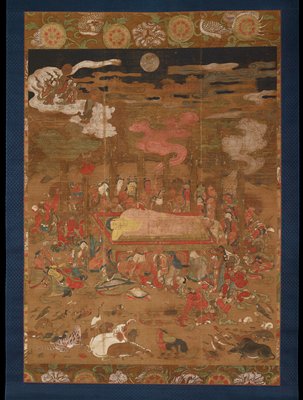
Parinirvana of Sakyamuni, the Historical Buddha
- Medium
- Hanging scroll, ink, color, and gold on silk
- Dimensions
- 61 × 41 15/16 in. (154.94 × 106.52 cm) (image only) 85 × 48 1/2 in. (215.9 × 123.19 cm) (mount, without roller) 87 × 51 1/2 in. (220.98 × 130.81 cm) (with roller)
- Genre
- Paintings
Tags
Japan
About
Tradition holds that on a moonlit night some 2, 500 years ago, the historical Buddha, Sakyamuni, passed away, lying on a couch in a grove of holy sala trees in the Himalayan foothills. As this sacred painting shows, a diverse host of mourners—humans, divine beings, all variety of animal life—witnessed his passing. The Buddha had taught them that his death was not to be mourned. After all, he achieved the state of nirvana in this life, thus freeing himself from the endless cycle of rebirth and suffering. His death would mean the attainment of Parinirvana, a state of perfect bliss. Some of those in attendance could not comprehend his teaching, however, and can be seen wailing in grief. In Japan, paintings of this type are displayed annually on the fifteenth day of the second lunar month, when the Nirvana Assembly (nehan-e) is held to commemorate the Buddha’s death.
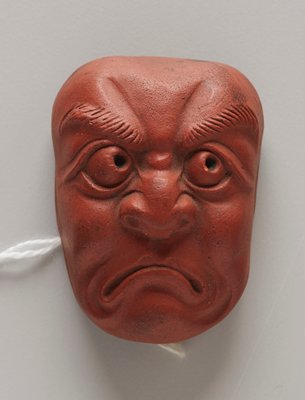

![Netsuke [dancer]](https://1.api.artsmia.org/30497.jpg)

![Netsuke [Fisherman with Cormorant]](https://1.api.artsmia.org/32067.jpg)