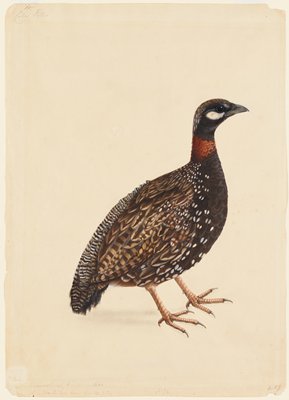
A Black Partridge
- Medium
- Opaque watercolor on paper
- Dimensions
- 14 3/4 x 11 3/8 in. (37.47 x 28.89 cm) (outer frame)
- Genre
- Paintings
Tags
India
About
“Company school” refers to a style of Indian painting that developed during the last quarter of the eighteenth century. With the decline of Mughal nobility at that time, Indian artists naturally turned to their British rulers for patronage. This attempt on the part of artists to work in a mixed Indo-European style that would appeal to resident Europeans employed by the various East India trade companies gave rise to the name “company school.” In this magnificent study of a black partridge, the artist has readily adapted to British ornithological conventions and a large format. The plumage of the bird, based on meticulous direct observation, is rendered with detailed accuracy and in naturalistic color in a style very different from classical Indian painting, with its flattened space, decorative coloration, and imagined compositions. In addition to natural-history subject matter, resident Europeans also collected architectural and botanical studies.