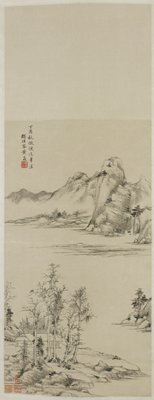
Landscape in the Manner of Ni Zan
Huang Ding
1717
- Medium
- Ink on paper
- Dimensions
- 36-1/2 x 13-13/16 in. (92.7 x 35.1 cm)
- Genre
- Paintings
Tags
China
About
Huang Ding, also known as Kuang Ting and Du Wang Ke, was from Changzhou in Jiangsu Province. Like many Qing orthodox painters, he was influenced by the aesthetic theories of Dong Qichang (1555-1636) and he studied the landscape of Song and Yuan masters. Signed paintings by Huang cite the styles of Dong Yuan (c. 900-962), Ni Zan (1301-1374), and Dong Qichang as inspiring his own work. This simply composed, dry-brush landscape featuring a one corner foreground composition with a stand of bare trees and a scholar's hut separated from distant mountains by a tilted water plane suggested by blank paper is a compositional formula first popularized by the great 14th century literatus Ni Zan. Huang captures the character of the antique in this work by absorbing the compositional elements and dry brush technique of earlier masters.