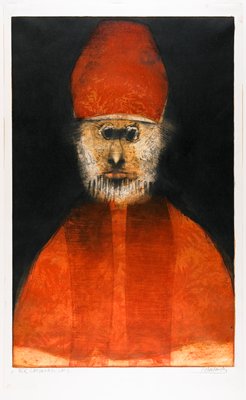
The Cardinal (El Cardenal)
- Medium
- Color engraving, etching, drypoint, soft-ground resist, water ground, aquatint, and electric stippler
- Dimensions
- 28 7/8 x 18 5/16 in. (73.34 x 46.51 cm) (plate) 31 3/4 x 19 3/4 in. (80.65 x 50.17 cm) (sheet)
- Genre
Tags
United States
About
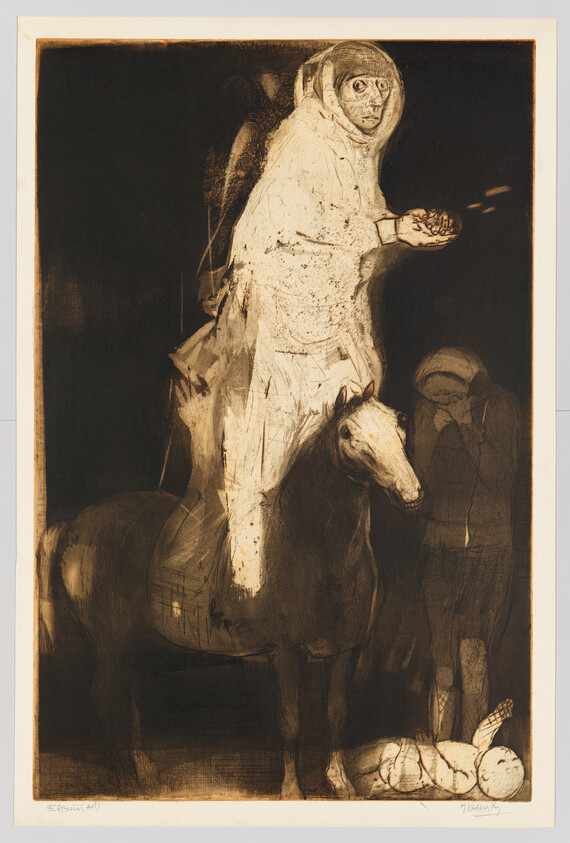
Mauricio Lasansky portrayed Catholic officials in a number of prints in the mid-1960s, inspired in part by the imagery he saw during his Guggenheim Fellowship in Spain (1953–54) of Catholic clergy and cardinals, in the work of El Greco, Diego Velázquez, and Francisco de Goya. Lasansky attentively depicted this figure’s old-fashioned ecclesiastic vestments—the red silk and damask chasuble and cope, the elaborate miter hat. Taken on its own, The Cardinal appears to be a straightforward depiction of a high-ranking religious figure. But considered alongside “The Nazi Drawings” (and Lasansky’s other prints of senior clergy), it is clearly a critique of Church hierarchy and its hypocrisy in failing to help the needy and vulnerable. The Vatican’s inaction during the Holocaust was much debated in the 1960s, particularly the failure of Pope Pius XII (1939–58) to condemn the Nazi atrocities or help the Jews. For Lasansky, who witnessed the alliance between the Catholic Church and fascist dictators in his native Argentina, the issue of the Church’s complicity was particularly sensitive.