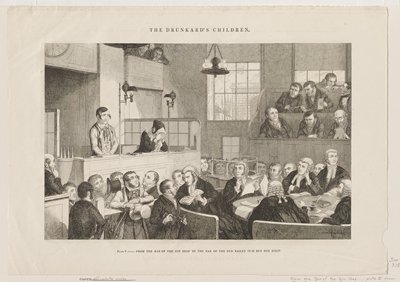
From the Bar of the Gin Shop to the Bar of the Old Bailey it is but One Step
- Medium
- Glyphograph
- Dimensions
- 8 7/16 x 13 3/16 in. (21.43 x 33.5 cm) (plate) 11 9/16 x 16 5/16 in. (29.37 x 41.43 cm) (sheet)
- Genre
Tags
England
About
In 1847, satirist George Cruikshank issued a series of low-cost prints, entitled The Bottle, which encouraged Britons – particularly the working poor – to renounce alcohol. The Bottle depicted a fictional family ravaged by alcoholism: the father is committed to an asylum, an infant dies, and the mother is murdered. The following year, Cruikshank issued an eight-part sequel, The Drunkard’s Children, from which this print derives. The series charted the courses of the family’s orphaned son and daughter. Among their misadventures are drinking, gambling, theft, and a visit to the courthouse where the brother is sentenced to life imprisonment in Australia, then a penal colony. A former heavy drinker, Cruikshank joined the temperance movement around the time he produced The Drunkard's Children; in 1856 he became vice president of the National Temperance League. While Cruikshank saw alcohol as a cause of crime and misery, many of his contemporaries regarded its abuse as a symptom of poverty.