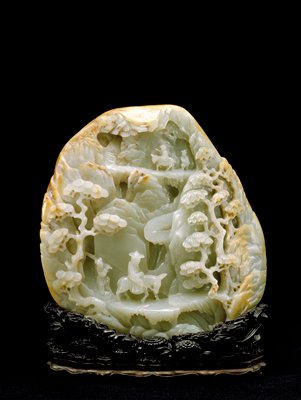
Traveling in Autumn Mountains
- Medium
- Grayish white nephrite with brown markings
- Dimensions
- 8 1/4 in. (20.96 cm)
- Genre
- Sculpture
Tags
China
About
In imperial China, horses—and their humbler counterparts, donkeys—were essential for travel, communication, and official duties, allowing scholars and administrators to traverse great distances. In this intricately carved jade mountain, an official rides a donkey across a bridge, followed by an attendant with an umbrella, while another pair appears in the distant heights. The layered landscape of pines, cliffs, and waterfalls evokes classical painting, expressing the literati ideal of harmony between humans and nature. Carved in a Qing imperial workshop, such jade sculptures translated revered landscape traditions into three dimensions, celebrating refined travel and the contemplative life of scholars.