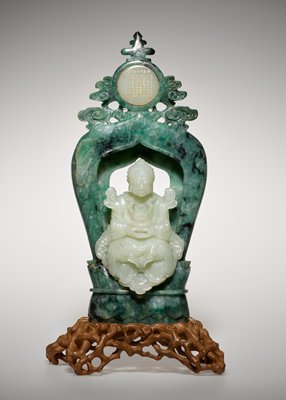
Amitabha
- Medium
- White and mottled green nephrite
- Dimensions
- 13 1/8 in. (33.34 cm)
- Genre
- Sculpture
Tags
China
About
Religious images in jade are relatively rare, and this figure of the Buddha Amitabha in contemplation makes an unusual use of contrasting colors of jade. When the Manchus overthrew the Ming in 1644, they adopted the Tibetan style of Buddhism as the official religion. During the eighteenth century especially, a great deal of state funding was directed toward temple construction and monastic renovation. This image was not likely commissioned for a temple, but rather a domestic altar for the court. The Buddha is shown here in dhyana mudra, the pose of deep contemplation which led to his enlightenment. The figure is seated on a stylized lotus pedestal, a Buddhist symbol for spiritual purity. The enframement in green jade is an open nimbus which takes the form of a Tibetan-style stupa. The inscription is in praise of Amitabha, the Buddha of Infinite Light, and states that the jade was commissioned by the court.