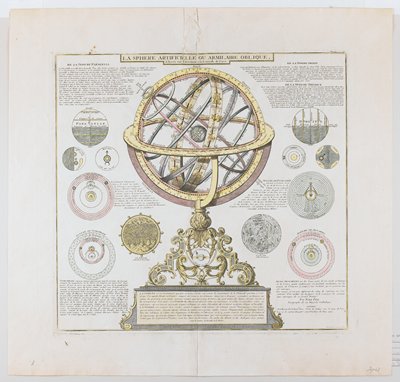
The Artificial or Oblique Armillary Sphere
Nicolas de Fer
1740
- Medium
- Hand-colored engraving
- Dimensions
- 15 7/8 x 16 5/8 in. (40.32 x 42.23 cm) (plate) 20 7/8 x 21 7/8 in. (53.02 x 55.56 cm) (sheet)
- Genre
Tags
netherlands
About
Ancient astronomers used the armillary sphere to measure the coordinates of stars. By the 17th century, the tool was regarded as too imprecise for scientists, but it found new life in the well-appointed libraries of rich burghers, where it became a chic curiosity and emblem of sophistication. This example shows the traditional model, with the Earth at the center of the universe. The graduated rings represent the primary celestial sphere, which includes the 12 constellations of the zodiac, the celestial equator, the meridian, and the latitude lines of the Earth projected into the sky. This complicated engraving also depicts four competing interpretations of the cosmos-those of Ptolemy, Copernicus, Tycho Brahe, and Descartes-as well as the uneven surface of the Moon (note the mountains and deep craters), first observed by Galileo in 1609.


