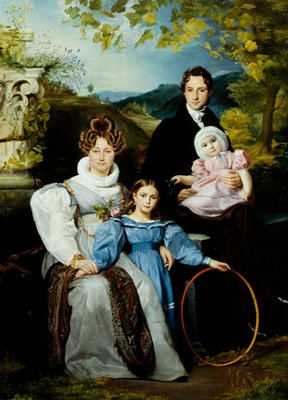
Portrait of the Moeremans Family
- Medium
- Oil on panel
- Dimensions
- 88 x 64 1/4 in. (223.52 x 163.2 cm) (panel) 98 1/8 x 74 3/8 in. (249.24 x 188.91 cm) (outer frame)
- Genre
- Paintings
Tags
belgium
About
This portrait represents a prosperous middle-class Belgian family. Gaspard Moeremans, the father, was a banker, a member of the board of the Bank of Holland, and later a judge on the Brussels court. He was 39 years old in 1831, the year the portrait was executed. Marie Matthieu, his wife, was pregnant, and only the older child appeared in the picture originally: the seven-year-old daughter Catherine. The artist completed the painting and signed it, but left a space in the composition for the coming child, their son Emmanuel Henri, who was added to the portrait two years later. Thus the painting is signed and dated twice, in 1831 and 1833. Just the year before the portrait was commissioned, Belgium had been convulsed by a popular uprising that culminated in the country's proclamation of independence from Holland. During the political turbulence, Moeremans was attacked in the press for his association with the Dutch government and the Moereman family's house was pillaged. He nonetheless managed to re-establish himself under the new regime. This portrait, painted soon after the turmoil, was probably destined to hang in the family's home, and may have been intended to express its [members'] relief at having safely weathered the crisis. Further, the Moeremans' decision to have a portrait painted, with all the time and money that that entailed, constituted a real statement of affirmation about themselves and their family. Some of the picture's elements are symbolic, such as the two roses in the bodice of Mrs. Moeremans' gown: one, full-blown, represents her daughter, who was already born when the painting was first executed. The other, a bud, represents the child, who was then still in the womb. Catherine holds a child's hoop - a toy - but also a symbolic allusion to her namesake Saint Catherine of Alexandria, who was martyred on a wheel; the tiny spikes on the inner rim of the hoop make this clear. One element is not symbolic: the infant boy's pink dress; the preference for dressing girls in pink and boys in blue is a twentieth century invention, and all infants wore dresses at that time. The painter François-Joseph Navez is most highly regarded today for his portraits, which have occasionally been confused with those of his teacher, the French Neo-Classical painter J. L. David. Navez's clientele for portraits, sacred pictures and scenes of daily life included international royalty. In Belgium, he enjoyed a long and successful career as the country's premier painter and director of its Academy of Fine Art. The painting is remarkably well-preserved, probably because it spent over a century in the care of the Moeremans' descendants. Its construction is unusual: it is painted on ten vertical wood panels that are joined together. With the natural expansion and contraction of the wood due to changes in humidity, it could easily have suffered serious damage. Instead, the artist's painstakingly factual approach, adept mimicry of textures and gleaming paint surface are all beautifully preserved, evoking a vivid sense of human life.