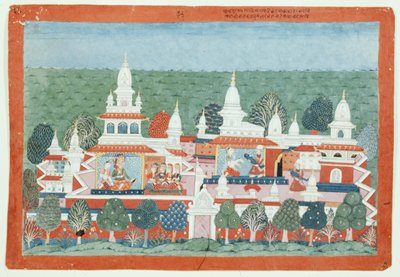
The Story of Pradyumna’s Birth
Nepal
1775
- Medium
- Opaque watercolors on paper
- Dimensions
- 12 3/4 x 19 1/4 in. (32.39 x 48.9 cm)
- Genre
- Paintings
Tags
Nepal
About
Beginning in the mid-seventeenth century, the Nepalese royalty of the Kathmandu Valley became increasingly interested in Rajput paintings from India. Originally influenced by the Malwa and Kangra schools, Nepalese artists nevertheless developed an original spatial sense that utilized bird’s-eye views and multiple perspective. Set within a highly decorative landscape and elaborate palace, this scene is from the great Sanskrit chronicle of Vishnu, the Bhagavata Purana. It features the son of Krishna, Pradyumna, who was preordained to kill the demon king Sambara. Sambara threw the days-old infant into the sea, where he was swallowed by a fish that was soon caught and offered as a gift to the king. In the right side of the painting, the blue infant, having been discovered in the fish, is presented to Mayavati, goddess of love, in the kitchen of the palace where she worked. Mayavati secretly raised Pradyumna and eventually became consort to King Sambara. She is shown seated with him, holding court on the left side of the palace. Upon reaching manhood, Pradyumna slew the demon king, as he was born to do, and married Mayavati.