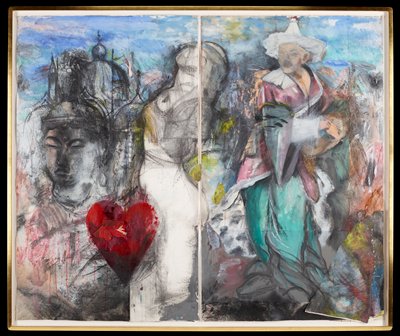
San Marco with Meissen Figure and the Buddha
Jim Dine
1988
- Medium
- Watercolor, oil paint, pastel, charcoal, shellac, and collaged paper, two sheets
- Dimensions
- 79 x 47 in. (200.7 x 119.4 cm (sheets, two) 79 x 95 in. (200.7 x 241.3 cm) (overall) 83 1/2 x 99 5/8 x 2 5/8 in. (212.09 x 253.05 x 6.67 cm) (outer frame)
Tags
United States
About
Jim Dine’s impulse to range across cultures is evident here. He fills the Piazza San Marco of Venice (where he had a studio) with objects summoned from his “romantic unconscious.” As he put it, “I have some sort of cultural DNA link with the ancient world.” The arching figure with the exposed arm socket is the so-called Dresden Maenad, after a Hellenistic sculpture. The Buddha and the silhouette of the basilica of San Marco, with its Byzantine and Gothic influences, are juxtaposed in a confluence of Buddhism and Christianity. The white-hatted guitar player at right is based on a Meissen porcelain figure—enlarged roughly six times. Dine’s work typically carries the marks of its making. This drawing is assembled from six pieces of paper that are full of abrasions, tears, obliterated fibers, staple holes (and even an errant staple). The large affixed paper fragment in the lower right corner lifts the musician’s robe into our space. Through varied borrowings, Dine connects his art to venerated artistic traditions, adding his own work to the continuum of art history.

![Ten Winter Tools [adjustable wrench]](https://api.nga.gov/iiif/9aa3fc52-54e5-40ad-aab4-8fdff1878601/full/843,/0/default.jpg)