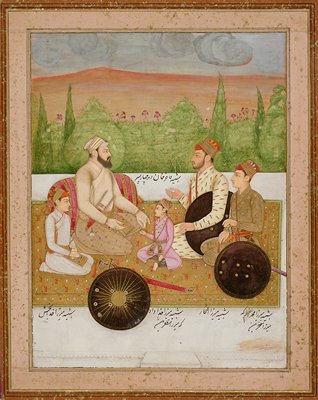
Portrait of Fakir Khan and His Sons
India
1690
- Medium
- Ink, colors and gold leaf on paper
- Dimensions
- 15 3/8 x 11 3/8 in. (39.05 x 28.89 cm) (sheet)
- Genre
- Paintings
Tags
India
About
Fakir Khan, shown seated here with his four sons, was a member of Shah Jahan's court (reigned 1627-58) at Delhi; each sitter is identified in Persian. Royal portraiture was introduced to India with the Mughal conquest in the sixteenth century. Many of these idealized portraits reveal subtle modes of representation through which Indian rulers reasserted their power and achievements. For instance, Fakir Khan's royal status is conveyed by the subtle aureole behind his head, while the family's political importance is indicated by the ceremonial swords, daggers, and shields each member possesses. Finally, the hierarchy within the family is indicated by the size of each figure; the sons are otherwise all treated as miniature adults, with little indication of age based on facial features.