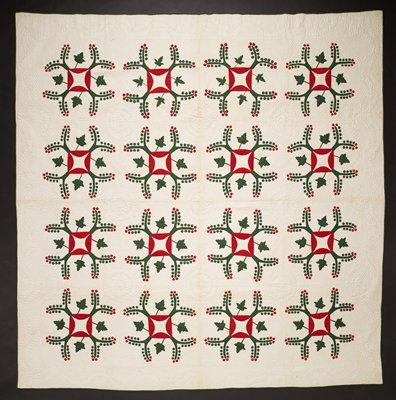
Cherry quilt
Mary Jones
1859
- Medium
- Cotton, pieced, appliquéd, and quilted
- Dimensions
- 95 x 97 in. (241.3 x 246.38 cm)
- Genre
- Textiles
Tags
United States
About
Mary Ellen Jones completed what she called her “cherry quilt” in 1859, when she was twenty years old. Typically, quilts have three layers: a cloth top; a middle layer of cotton batting, cloth, or even paper; and a cloth backing. This one lacks a middle layer, a design choice that facilitated Jones’s fine stitching. She packed up to fourteen tiny stitches into one inch of hand quilting. Today, expert hand quilters aim for ten stitches per inch. The original fabric glazing—shiny areas on the cloth’s surface—is still present, suggesting that the quilt was never washed and that it was made for display, not for use as a blanket. The appliquéd leaves (resembling grape rather than cherry leaves) enliven the symmetrical design. The color scheme reflects the craze for red and green quilts that swept the United States in the mid-1800s.
