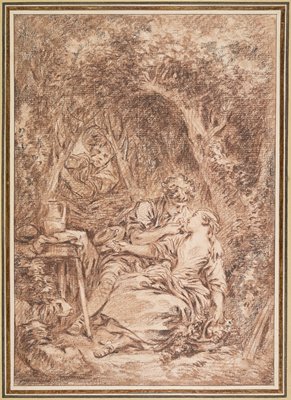
Lovers Surprised (Annette et Lubin)
François Boucher
1760
- Medium
- Brown and black chalk, with touches of brown wash on paper
- Dimensions
- 10 3/4 x 7 7/16 in. (27.31 x 18.89 cm) (image) 13 1/4 x 10 5/8 in. (33.66 x 26.99 cm) (mount) 18 1/2 × 14 1/8 × 7/8 in. (46.99 × 35.88 × 2.22 cm) (outer frame)
Tags
france
About
In François Boucher’s world, gods and goddesses, shepherds and shepherdesses, voluptuous nymphs, enchanting peasants, dewy adolescents, and adorable winged infants cannot help but fall in love. This highly finished sheet from his later years demonstrates Boucher’s ability to interpret with freshness and tenderness the intimate moments shared by lovers. The subjects have been identified as Annette and Lubin, characters from a story by Jean-François Marmontel popularized in a comic opera in 1762. Orphaned cousins, living together in an alpine hamlet, the two innocently fall in love, make love, and then are comically unaware of the resulting pregnancy until it is pointed out by the village bailiff (possibly the young voyeur in Boucher’s drawing). Omitting his signature eroticism, Boucher instead portrayed the lovers’ innocence. Childlike and small in stature, the couple are fully clothed, even shod, with little flesh revealed. The youth’s gentle embrace of the girl seems more protective than lustful, as he woos her with a fragrant flower, perhaps taken from her basket.