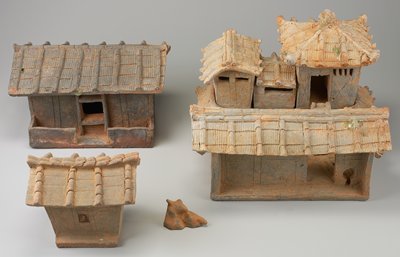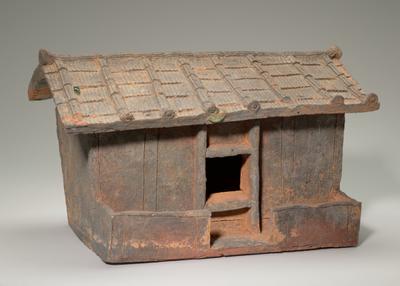
Grain Storage Building, from a model farmstead
- Medium
- High-fired earthenware
- Dimensions
- 7-5/16 x 12-5/16 x 8-3/16 in. (18.6 x 31.3 x 20.8 cm)
- Genre
- Ceramics, models
Tags
Vietnam
About
The Chinese occupation of the fertile river valleys of northern Vietnam (111 BCE–938 CE) influenced Vietnamese potters to varying degrees. Most pronounced was in the Han-Viet period (111 BCE–c. 200 CE), when the Chinese burial custom of interring ceramic models, often vignettes of everyday rural life, into aristocratic tombs became widespread. Frequent themes include the model farmstead; here, it consists of a walled courtyard, a ladder to the second-story living quarters, animal pens, and humble grain storage buildings. Although intended to accompany the deceased into the afterlife, excavated models clearly and charmingly depict the architecture of the period and place.