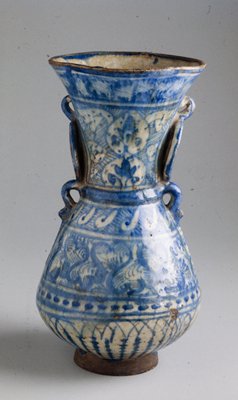
Footed Vase with Applied Ring Handles
- Medium
- Earthenware, underglaze cobalt blue
- Dimensions
- 13 3/4 in. (34.93 cm)
- Genre
- Ceramics
About
Although the shape of this vase imitates Chinese models of the Yuan dynasty (1280-1368) with attached ring handles, its flaring neck shows the potter's greater familiarity with the glass mosque lamps of the Mamluk period. The decoration of Mamluk blue-and-white pottery imitates Ming porcelains of the Hsuan-te reign (1426-35), but the inability of Middle Eastern potters to control vessel shapes and underglaze designs as well as the Chinese is apparent in this early example of blue-and-white. This rare vase was, however, considered worthy enough to be signed by its maker, Men'l'Ezz, who is known for a similar vase in the Islamic Museum in Cairo and fragments in other museum collections.