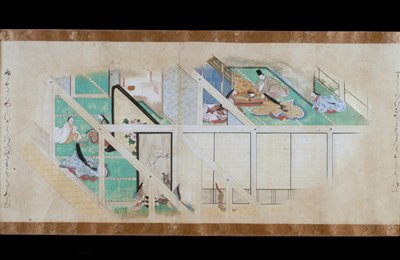
A Story of Crickets
- Medium
- Ink and color on paper
- Dimensions
- 12 1/4 x 169 in. (31.12 x 429.26 cm)
- Genre
- Paintings
Tags
Japan
About
One of the great Japanese contributions to pictorial art is the emaki, or picture scroll. Although the format first developed in China, the Japanese combined their own narrative subject matter with their unique decorative painting style (yamato-e), to create a new, distinctly Japanese art form. Buddhist legends, literary and historical works, biographies and fables were all illustrated in lively compositions accompanied by elegant text. This story concerns the birth of a son in an aristocratic family. The characters wear lavish costumes popular during Japan's Heian period (794-1185). The artist also makes use of a stylistic device developed at that time know as fukinuki-yatai, or torn away roof, to better show the action within architecture. The story also typifies the wit and humor often encountered in Japanese painting, for the characters are depicted not as Heian aristocrats, but as grasshoppers and other animals.