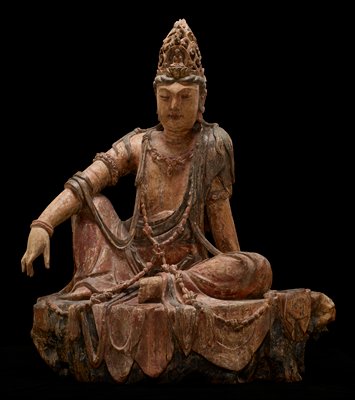
Avalokiteshvara Bodhisattva in the Water-Moon Form (Shuiyue Guanyin)
- Medium
- Wood, gesso and pigments
- Dimensions
- 40 1/2 x 33 1/2 x 20in. (102.9 x 85.1 x 50.8cm)
- Genre
- Sculpture
Tags
China
About
Of the many manifestations of the bodhisattva Avalokiteshvara, perhaps none was more prevalent in East Asia than the uniquely Chinese form known as “Water-Moon Avalokiteshvara, ” which later also spread to Korea and Japan. This form of the bodhisattva presides over his own paradise, Potolaka, which is described in scripture as a rugged seaside cave from which Avalokiteshvara could admire the reflection of the moon in the water. Appropriately, he appears meditative and relaxed and is seated informally in the “royal-ease” posture. Ornately dressed, with silk robes, fluttering sashes, jewelry, and an elaborate hairstyle, he also wears a headpiece that features an image of Amitābha, the buddha to whom Avalokiteshvara attends. Believers might look to a sculpture like this as a guide for their own journeys toward enlightenment.