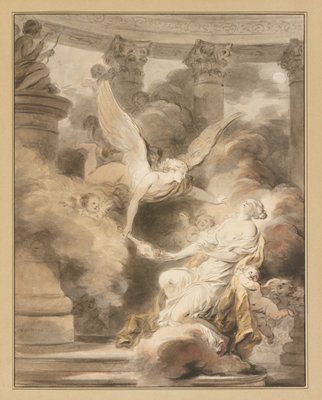
The Sacrifice of the Rose
- Medium
- Brush and gray and brown wash, red and yellow watercolor, over black chalk on paper
- Dimensions
- 16 5/8 x 13 in. (42.2 x 33.0 cm) 21 3/4 x 18 1/8 in. (55.3 x 46.0 cm) (board) 26 1/16 x 23 1/16 x 1 in. (66.2 x 58.6 x 2.5 cm) (outer frame)
- Genre
- Drawings
Tags
france
About
In this highly finished drawing, two lovers are represented as mythical heroes partaking in a sacred ritual. In a cloud-filled ancient temple, a beautiful maiden offers a rose to Cupid, whose statue is perched high on a pedestal. A handsome winged man—variously identified as Eros, Amor, or Hymen (god of marriage, whose attribute is a torch)—hovers near her, gazing attentively as he torches her flower and she swoons in rapture. Quite obviously this is an allegorical representation of sexual ecstasy and a woman’s loss of virginity. The dramatic play of light and dark, the evocative atmospheric effects, and the general composition all show the influence of Italian Baroque art, which Fragonard admired and studied avidly during two stays in Italy. Gianlorenzo Bernini’s Ecstasy of Saint Teresa was a primary inspiration. Fragonard slyly recast Bernini’s angel and virgin saint as lovers, adopting similar poses, expressions, and dress. The curving Corinthian colonnade of Fragonard’s temple of love recalls the architecture in Bernini’s work. These borrowings lend the work a spiritual dimension.