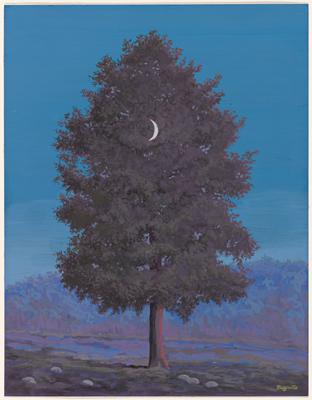
The Sixteenth of September
René Magritte
1956
- Medium
- Gouache over graphite on paper
- Dimensions
- 14 x 10 7/8 in. (35.56 x 27.62 cm) (sheet) 24 × 20 × 1 1/4 in. (60.96 × 50.8 × 3.18 cm) (outer frame)
- Genre
- Drawings
Tags
belgium
About
The Belgian Surrealist artist René Magritte liked to surprise and confound viewers. In The Sixteenth of September, the moon has left its orbit and attached itself to a tree, yet Magritte’s dispassionate and careful brushwork makes the whole scene look matter-of-fact. Shifts in size and gravity were some of his favorite tactics for urging viewers toward awareness. He switched background and foreground, so that instead of seeing the moon through the tree, we see the tree behind the moon. A few daubs of white pigment in the landscape erase deep space, disturbing our notion of pictorial depth. There is also the matter of scale. A waxing crescent this size makes sense against the sky, but here, superimposed on the tree, it still looks as if it were 238, 855 miles away.