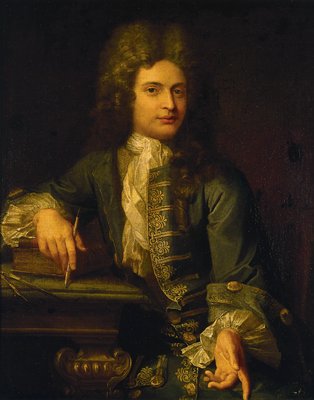
Portrait of a Man, possibly Filippo Schor
Paolo de Matteis
1690
- Medium
- Oil on canvas
- Dimensions
- 36 3/8 x 29 1/4 in. (92.4 x 74.3 cm) (canvas)
- Genre
- Paintings
Tags
Italy
About
This painting was thought to be English or French before scholar Pina De Angelis recently identified the unknown sitter portrayed as a gentleman draftsman as the Italian artist Filippo Schor (1646–1715). Filippo Schor trained in Rome with his famous father Johann Paul Schor (1615-1674), an Austrian painter and designer, who ran a successful studio in the papal capital that excelled in baroque spectacle and decoration. Young Filippo brought those skills with him to Naples, where he moved in 1683, working as a painter, architect, festival designer, and theater director for the Spanish viceroys. De Angelis suggests that the Minneapolis portrait was part of a well-known series of four portraits commissioned by don Francisco IV de Benavides, conte di Santisteban, viceroy of Naples from 1688 to 1696. The paintings portrayed four virtuoso talents in the Neapolitan music scene working under the count's patronage. Santisteban brought the portraits back to Madrid with him when he returned to Spain, and the works can be traced in the inventories of his descendants until the 19th century. While the portrait of Schor was last recorded in an 1877 inventory, the other three in the series are known: "Portrait of Alessandro Scarlatti" (Fundación Casa de Alba, Palacio de Liria, Madrid), "Portrait of Matteo Sassano, 'Matteuccio'" (Madrid, Museo Nacional de Artes Decorativas), "Portrait of Pietro Ugolino, 'Petruccio'" (Museum of Fine Arts, Richmond, Virginia). De Angelis suggests the Minneapolis painting is the missing portrait of Filippo Schor. Despite the illustrious commission and provenance of the Italian portrait series, the artist responsible for them has been a mystery and was never recorded in the inventories. De Angelis attributes the four to Paolo de Matteis, an important south Italian painter who worked for the Spanish viceroys in Naples. De Matteis was active in the city between 1683 and 1702, just when Santisteban was viceroy (1688–1696). As the composer Scarlatti returned to Rome in 1690, the series must have been completed at that time, or at least begun. The men's fashion further suggests this date We are grateful to Pina De Angelis for sharing her research and insights about the Minneapolis portrait and clarifying the provenance; see Pina De Angelis, "I 'Quatro Retratos de los Virtuosos' di Paolo de Matteis, " in "Ricche Minere, " 20 (2023), pp. 151-57.