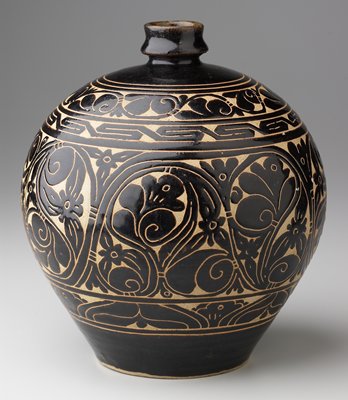
Ovoid Bottle
- Medium
- Huairen ware Stoneware with dark-brown glaze and cut-glaze decoration
- Dimensions
- 8 9/16 x 7 11/16 in. (21.75 x 19.53 cm)
- Genre
- Ceramics
Tags
China
About
Probably intended for wine, this ovoid bottle is covered with a nearly black glaze into which a decorative scheme was incised and carved before firing. The dark glaze design elements appear against the light grey ground of the exposed body clay. Commonly known as the cut-glaze technique, this decoration was most likely inspired by the partially glazed brown and white ceramics produced during the Tang dynasty (ninth century) at the Huangbu kilns. The technique was fully developed at a number of Cizhou type kilns during the early Northern Song (960-1127) and it rose to prominence during the Jin period (1115-1234). This particularly fine example with precisely carved floral patterns was made in the Huairen kilns in northern Shanxi province.