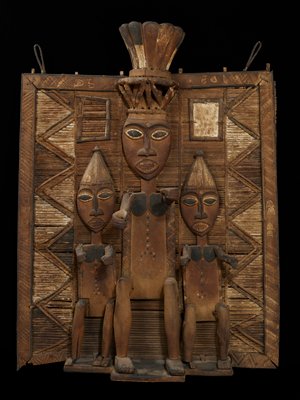
Funerary screen
- Medium
- Wood, raffia, pigment
- Dimensions
- 37 1/2 x 28 x 9 3/4 in. (95.3 x 71.1 x 24.8 cm)
- Genre
- Funerary goods
Tags
Nigeria
About
As middlemen of the trans-Atlantic trade from the 1500s onward, the Kalabari peoples who live in the coastal Niger River delta area were in close contact with Europeans and their two-dimensional images. It seems likely that prints and paintings inspired the tradition of ancestral screens, which began around 1800. Their construction shows knowledge of European joinery techniques, learned from ships’ carpenters. Reserved for the heads of powerful trading houses, they offered the spirits of the dead a place to regularly return, receive offerings, and follow the business of their descendants. The central figure of the deceased, flanked by two dependents, is shown wearing a feathered masquerade headdress.