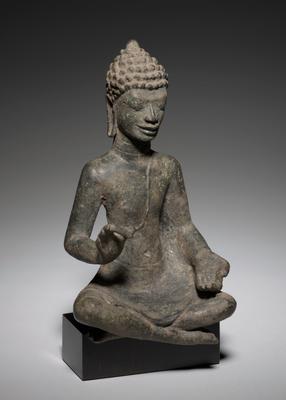
Seated preaching Buddha
- Medium
- Bronze
- Dimensions
- 7 1/8 x 3 1/8 x 1 7/16 in. (18.1 x 7.94 x 3.65 cm)
- Genre
- Sculpture
Tags
Thailand
About
This upright seated Buddha demonstrates the mixing of Mon-Dvaravati style with the earliest pan-Asian conventions. The depiction has characteristically plump lips, described as bee-stung in Indian texts from about the 400s CE. Yet his wide mouth, flat nose, continuous eyebrows, and wide-set eyes are hallmarks of the style during this Thai kingdom (c. 600s–1000s). The Buddha’s right hand is in the gesture of exposition, or teaching, while the left is lowered to offer blessings. He sits relaxed in open-robe pose, with traditional attributes, such as distended earlobes (signifying the burdensome earrings of his former princely life), three beauty marks on the neck, a cranial protuberance, and hair in snail-shell curls. The slightly parted lips and raised corners of his mouth evoke other qualities, such as a sweet and resonant voice.