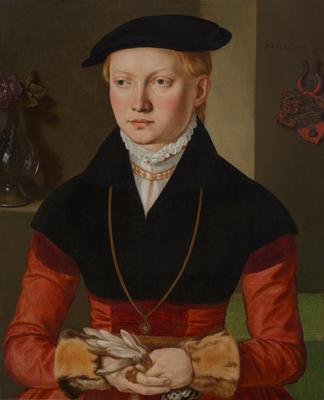
Portrait of a Young Woman, possibly Christina Schweitzer (née Hoffman)
Georg Pencz
1547
- Medium
- Oil on canvas
- Dimensions
- 24 1/8 x 19 5/8 in. (61.28 x 49.85 cm) (canvas)
- Genre
- Paintings
Tags
Germany
About
The historic frame, a Genoese late 16th-early 17th century walnut cassetta frame, is a gift of the Douglas and Mary Olson Frame Acquisition Fund. Dressed in a black beret, red dress with velvet trim and fur cuffs, white blouse, and short black vest, the young woman in this portrait is 20 years old (note inscription). She probably lived in Nuremberg, Germany, where Georg Pencz was a successful painter and engraver. Female portraits by him are rare. This one is likely a marriage portrait, commissioned as a pendant to a portrait by Pencz in Munich portraying a man in a matching outfit—black beret, red coat, white shirt, and black cloak. The two paintings would have formed a unified pair, with similar backgrounds adorned with prominent coats of arms and shelves bearing water-filled glass vessels. The crest on the Mia portrait cannot be identified, but based on the crest in the Munich painting they might represent the couple Thomas Schweitzer and Christina Hoffman. Scholar Katrin Dyballa (2014) was the first to connect the two portraits and suggest they represent the married couple Thomas Schweitzer and Christina Hoffman of Nuremberg, Germany. While an earlier identification of the male sitter as Lienhard Hirschvogel can be rejected based on the appearance of the Schweitzer family arms in the Munich portrait, the family crests in the Minneapolis painting eludes identification to confirm Dyballa's compelling proposal with certainty. Georg Pencz was the official city painter of Nuremberg when he made this portrait. He had been briefly banished from the city in 1525 for supported radical Protestantism, in defiance of the City Council that was thoroughly Catholic at the time. Just a few weeks later, however, the city switched to the Protestant side and Pencz was welcomed back into its good graces.