Bratatat!
Roy Lichtenstein
1962
- Medium
- Graphite and frottage on Arches paper
- Dimensions
- 20 1/2 x 16 1/4 in. (52.07 x 41.28 cm) (image) 25 1/2 × 20 3/16 in. (64.77 × 51.3 cm) (sheet) 32 3/4 x 27 1/8 x 1 7/16 in. (83.19 x 68.9 x 3.65 cm) (outer frame)
Tags
United States
About
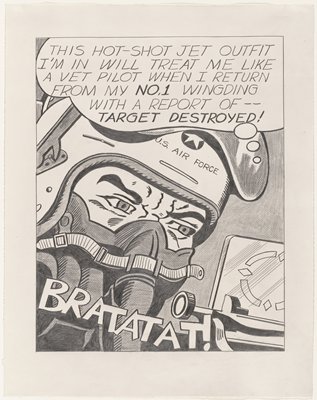
Comic books were important sources for Roy Lichtenstein’s early Pop experiments, especially the genre’s distinctive pictorial conventions. The artist began Bratatat! by making a small freehand drawing based on a single comic strip panel. He then redrew the composition, much enlarged, with the aid of an opaque projector. He intentionally mimicked commercial printing, using flat areas of tone, strong contrasts, precise outlines, and stylized shading. He also rubbed the paper on perforated metal sheets to simulate the Benday dot pattern common to cheap photomechanical reproduction. For Lichtenstein, the process of manipulating and altering the source image while retaining the quirky conventions of comics was critical to the work’s ultimate meaning as fine art.

![Untitled [house]](https://whitneymedia.org/assets/artwork/61790/2019_234_28_cropped.jpg)
![Untitled [mirror]](https://whitneymedia.org/assets/artwork/61795/2019_234_33_cropped.jpg)