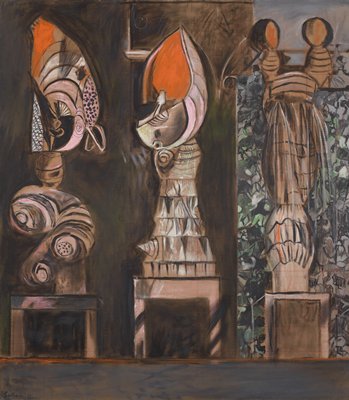
Three Standing Forms in a Garden
- Medium
- Oil on canvas
- Dimensions
- 52 1/2 x 45 1/2 in. (133.35 x 115.57 cm) (canvas)
- Genre
- Paintings
Tags
England
About
Throughout his career, the British painter Graham Sutherland used semi-abstracted, haunting shapes that, like visual metaphors, designated completely different objects. The artist believed that art’s duty was not to replicate the appearance of objects but to explain their essence through a substitution of forms. At mid-career, Sutherland created several highly sculptural, monumental standing forms that employed organic shapes to evoke the essence of the human figure. In Three Standing Forms in a Garden, the artist includes abstracted components such as bamboo roots for the lower part of the figure at left, a conical pillar of stacked corn for the trunk of the middle figure, and gourds and hanging maize for the form at far right.