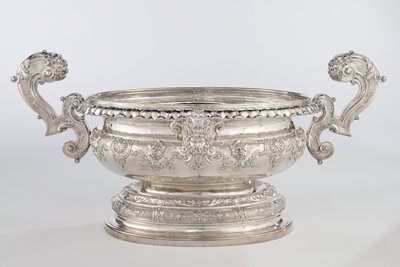
Wine cistern
Paul de Lamerie
1719
- Medium
- Silver
- Dimensions
- 18 x 38 x 25 in. (45.72 x 96.52 x 63.5 cm)
- Genre
- Metalwork
Tags
England
About
Paul de Lamerie registered his first mark in 1712, only seven years before the creation of this masterpiece. This is the earliest known example of his highly decorative style, showing exceptional imagination and unexpected power in both form and ornament. Similar pieces in the French taste had been made by other goldsmiths before him, but at the time de Lamerie created this cistern, work of this importance and scale was virtually unknown. <P>Bold, faun-like masks spring from the body to support the vigorous leaf rim. Moulded panels on a Régence scale-pattern ground enclose grotesque marks, and scrolls and shells are chased on the base. The superbly proportioned vessel is given power and individuality by two eccentrically-shaped handles bearing animals' masks on the upper volutes. The sum of the parts demonstrates Paul de Lamerie's ability to produce, even in the early years of his career, a massive piece of highest quality. During large banquets and parties, cisterns were used to chill wine bottles in cool water. This cistern was made for John Leveson-Gower, 1st Earl Gower, in 1719. His grandson, George Granville (1758-1833), was made 1st Duke of Sutherland in 1833. The cistern remained in the family from 1719 to 1961 when it was acquired by the Institute.