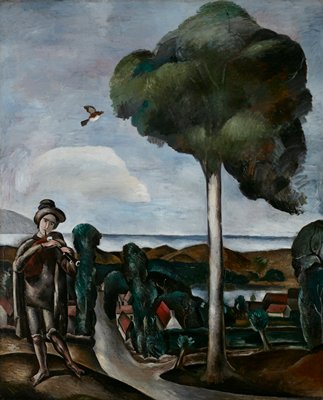
The Bagpiper
André Derain
1910
- Medium
- Oil on canvas
- Dimensions
- 71 1/2 x 58 in. (181.61 x 147.32 cm) (sight) 80 x 65 3/4 x 3 in. (203.2 x 167.01 x 7.62 cm) (outer frame)
- Genre
- Paintings
Tags
france
About
Although Derain had helped found Fauvism and had been an early adherent of Cubism, he increasingly fell away from both aesthetics, feeling their obsession with technique had supplanted the content of their work. Derain, instead, began to turn toward the Old Masters, even as he kept pace with the spirit of his own time. Thus, while The Bagpiper at Camiers owes much to Cézanne in color, brushwork and composition, a great debt to the Old Masters is also evident, especially the arcadian scenes peopled with shepherds and musicians by Titian, and Derain's countryman, Claude Lorrain. The Bagpiper at Camiers became one of Derain's best known pre-war pictures and its lyrical and romantic feeling established him as an artist in the grand tradition of large formats and timeless subjects.