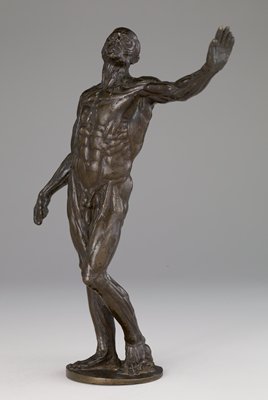
Anatomical Man (Ecorché)
Italy
1600
- Medium
- Bronze
- Dimensions
- 13 3/4 x 8 1/8 x 5 7/8 in. (34.93 x 20.64 x 14.92 cm)
- Genre
- Sculpture
Tags
Italy
About
Through its active stance, this ecorché (literally, a flayed figure) becomes a living cadaver. The pose, drawn from classical statuary, provides an excellent opportunity to display the muscles in action, notably seen here in the differing tensions and movements of the shoulder, neck, and thigh muscles. The ecorché demonstrates the practice of anatomical representation that arose during the Renaissance from an interest in the human body and its functions. Illustrated anatomy books, and particularly Vesalius' Fabrica, published in 1543, established the activated flayed corpse as the dominant type of anatomical representation. It remained so until the Borghese Gladiator was discovered around 1610 (see the full-scale cast in this gallery). This provided a new model for the study of muscular anatomy as an intact, healthy body.
![[Woman with sword]](https://1.api.artsmia.org/112348.jpg)