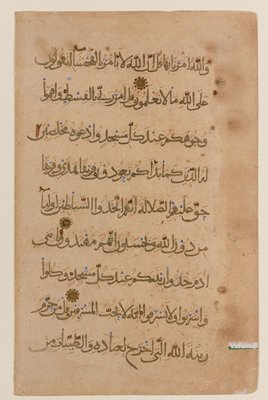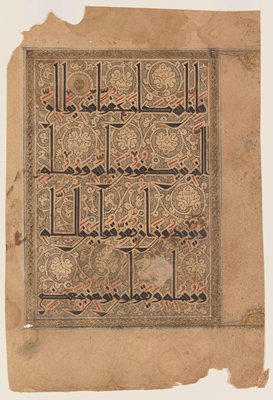
Page from the Qur'an
Persia
1037
- Medium
- Ink and colors on paper
- Dimensions
- 10 1/2 x 8 in. (26.67 x 20.32 cm) (sheet)
- Genre
- Manuscripts
Tags
iran
About
This double-sided page comes from the Qarmathian Qur’an, among the most lavish produced in the innovative calligraphic style known as “broken cursive.” Created using a qalam, a reed pen that was cut at an angle so the ink could be applied at different pressures and slants, this Qur’an is notable for the calligrapher’s lyrical interpretation of Arabic lettering, with vocalization marks elegantly expressed in strokes of red, blue, and green (now faded). The page is further distinguished by its rich background of scrolling vegetal motifs—ubiquitous in the aesthetics of the Islamic world. Recent conservation of this work was made possible by a generous contribution from Leela and Kevin Scattum.