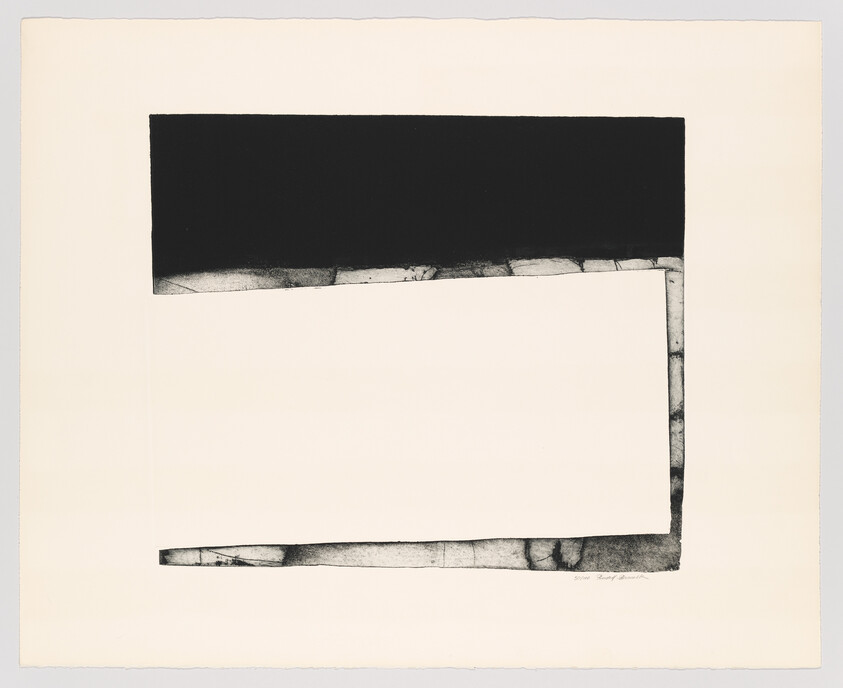
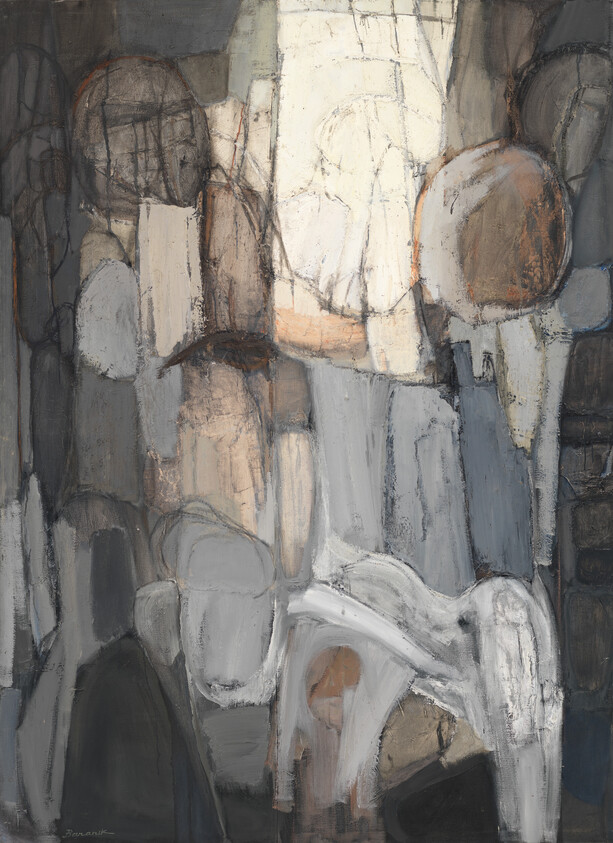
Night and Night
Rudolf Baranik
1972
- Medium
- Mixed media collage and oil on paper, mounted on cardboard
- Dimensions
- 18 5/8 × 14 7/8 in. (47.31 × 37.78 cm) (sheet) 22 × 18 1/4 × 1 7/16 in. (55.88 × 46.36 × 3.65 cm) (outer frame)
Tags
United States
About
Rudolf Baranik frequently described his creative practice as “socialist formalism,” an approach that paired humanist values with a formalist’s concerns with abstraction. Night and Night is part of an extended series of semi-abstract paintings and collages called the “Napalm Elegies” (1967–1974), including works inspired by a newspaper image of a young Vietnamese girl (Phan Thị Kim Phúc) badly burned by napalm. Napalm is a sticky and highly flammable substance used in bombs and flame throwers, and was employed by the U.S. Air Force and the Republic of Vietnam Air Force (VNAF) in bombing raids targeting Vietnamese combatants and civilian villages during the Vietnam War (1955–1975). Executed in a range of white and gray tones on a deep black ground, this and other works in the series relied on the public’s sobering understanding of napalm as a horrific weapon and a potent signifier of the anguish felt by many Americans about their country’s involvement in the Vietnam War.