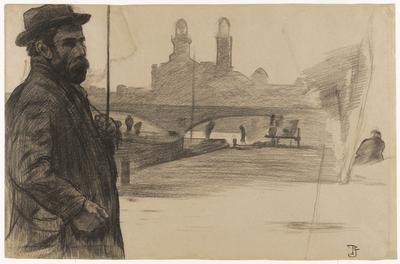
Man along the Seine with a View of the Old Trocadéro
- Medium
- Charcoal on beige paper
- Dimensions
- 12 3/8 × 18 7/8 in. (31.4 × 47.9 cm)
- Genre
- Drawings
Tags
france
About
Any Parisian in the early 1900s would have recognized the foreground figure as a clochard, meaning a vagabond or tramp and more specifically a person who lived along the quays and slept under bridges. Such figures were often romanticized in French literature, but Paul Jouve avoided idealization, seeking instead to capture their difficult existence. The figure’s possessions are in a bundle on his back, attached to the string he holds in his hand. Farther along the embankment, workers—perhaps clochards lucky enough to pick up a bit of paid work—transfer cargo between a wagon and a barge.