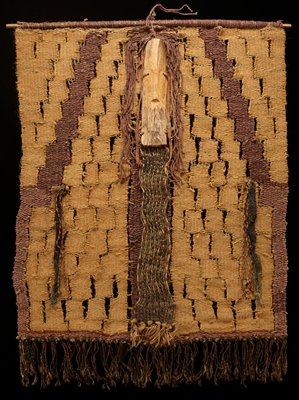
Mask
- Medium
- Wool, sisal, wood
- Dimensions
- 68 3/4 × 68 × 4 in. (174.63 × 172.72 × 10.16 cm) (including fringe)
- Genre
- Textiles, sculpture
Tags
Poland
About
In the mid-1900s, tapestry weaver Maria Laszkiewicz experimented with nontraditional weaving materials and sculptural elements in her studio in Warsaw, Poland. In creating Mask, Laszkiewicz primarily used the traditional French tapestry technique in which she was trained as a weaver. But her use of repeated vertical slits to achieve a geometric pattern is reminiscent of Incan textiles. This design choice, in combination with the central carved wooden mask that gestures to African sculpture, reveals Laszkiewicz’s interest in global artistic traditions.