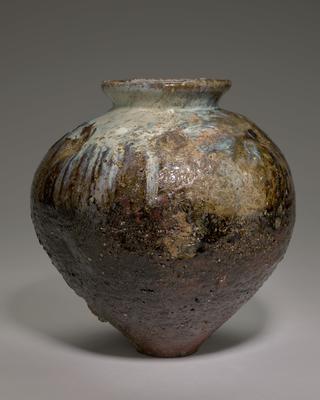
Chōsen Karatsu Jar
Maruta Munehiko
2017
- Medium
- Chōsen Karatsu ware, glazed stoneware
- Dimensions
- 9 7/16 × 9 1/4 × 9 1/4 in. (24 × 23.5 × 23.5 cm)
- Genre
- Ceramics
Tags
Japan
About
Karatsu-ware, or Karatsuyaki, is crafted from rough, coarse, iron-rich clay that fires to a distinctive reddish-gray color and encompasses a variety of styles. Karatsu, one of Japan's most renowned pottery towns, aptly means “port to Tang (China).” Historically, the town has served as a major trading hub connecting Korea, China, and the rest of Japan. The development of Karatsu-ware began over 400 years ago, significantly influenced by the arrival of Korean craftsmen brought to Japan by warlords invading Korea. These skilled potters created ceramics for tea ceremonies, which became highly popular among the Japanese elite of that era. However, from the Edo period (1603-1868) onward, the mountains were ruined because of an overabundance of kiln sites and the kilns were shut down by the local lords. In the 1910s, the potter Nakazato Muan (1895-1985) researched the old kilns and a revival of Karatsu-ware followed.