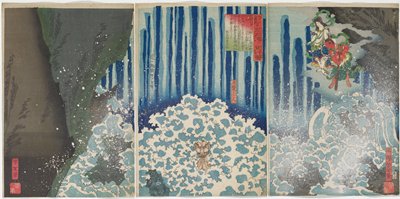
Picture of Penance under the Waterfall at Mount Nachi
- Medium
- Woodblock print (nishiki-e), ink and color on paper
- Dimensions
- 14 7/8 × 10 1/8 in. (37.78 × 25.72 cm) (image, sheet, vertical oban triptych; each sheet)
- Genre
Tags
Japan
About
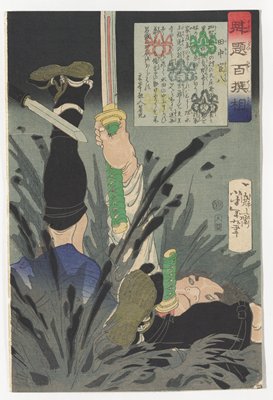
According to legend, after the young samurai Endō Morito (1139–1203) mistakenly killed the object of his love, Kesa-gozen, he became a monk and took the name Mongaku. As a penance for his crime, he decided to stand for 21 days under the icy waterfall at Mount Nachi which, with an uninterrupted drop of over 400 feet, is the tallest in Japan. There he continuously recited incantations to the deity Fudō Myō-ō. After seven days he lost consciousness but was rescued by the deity’s child attendants, who helped him so he could complete his harsh task. Yoshitoshi originally designed only the center sheet, which, very dramatically, shows only Mongaku’s face and praying hands amid the water. Half a year later, the two flanking sheets were added to create a more panoramic view of the scene.