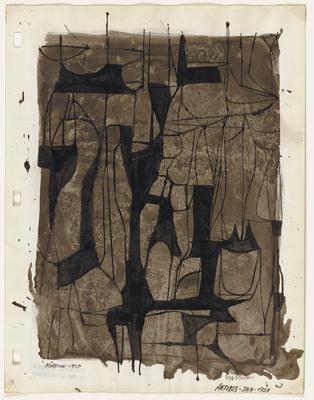
Untitled (Cap d'Antibes)
- Medium
- Black ink and wash on paper
- Dimensions
- 10 1/4 × 7 3/4 in. (26.04 × 19.69 cm)
Tags
United States
About
A member of the Anishinaabe people of the Grand Portage Reservation, George Morrison was active in the New York School of Abstract Expressionism, a mid-20th-century movement of avant-garde artists who saw abstraction as the essential vehicle for conveying intense emotion and exploring the unconscious through color, form, space, and gesture. In December 1952, after completing studies at the École des Beaux Arts in Paris, Morrison moved with his family to Antibes, a Mediterranean resort town on the French Riviera. There, he frequented the Cap d’Antibes, a rugged forested peninsula that offered him a stunning natural setting for observing the changing qualities of land, sky, and water. Morrison likely made this drawing in response to the distinctive rock formations he would have undoubtedly seen along much of the shoreline. Using intuition and the “automatic, ” or free-association drawing techniques of the Surrealists, he generated a geometric abstraction featuring a web-like pattern of interlacing lines and rectilinear shapes resembling the cape’s rocky outcroppings
![[Kirkwall, Scotland]](https://media.getty.edu/iiif/image/eb6b9a87-b709-49c8-995d-a78f5865b6b3/full/843,/0/default.jpg)