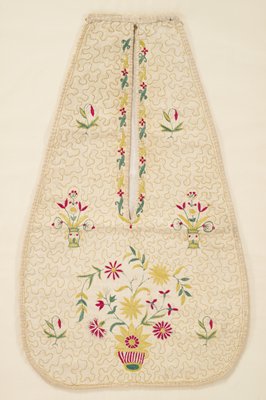
Embroidered pocket
- Medium
- Linen plain weave, silk embroidery
- Dimensions
- 16 3/16 × 10 in. (41.1 × 25.4 cm)
Tags
England
About
In the 1700s, European women wore pockets as a separate accessory attached to their waists, beneath voluminous skirts and petticoats. These accessories were generously sized – large enough to stash a container of smelling salts, a small bottle of perfume, a clutch of love letters, a portable almanac, perhaps even a pocket microscope. Women’s pockets were elaborately embroidered, despite the fact that they were seen only by the wearer and her intimates. The meandering yellow stitches on this pocket were common in the early 1700s. They were inspired by traditional embroidery from Bengal that featured naturally yellow wild silk on a cream fabric ground. When English tradesmen began importing Bengali fabrics in the late 1600s, local craftspeople quickly imitated these exotic goods. This pocket demonstrates that long-distance trade networks influenced the most intimate everyday objects, even a lady’s receptacle for personal treasures.