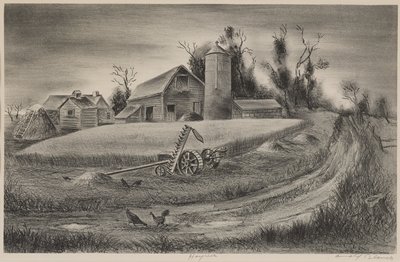
The Hayrick
Arnold Blanch
1939
- Medium
- Lithograph
- Dimensions
- 8 11/16 × 13 3/4 in. (22.07 × 34.93 cm) (image) 9 3/16 × 14 1/8 in. (23.34 × 35.88 cm) (sight) 16 3/4 × 20 3/4 × 1/2 in. (42.55 × 52.71 × 1.27 cm) (outer frame)
- Genre
Tags
United States
About
Born in Mantorville, Minnesota in 1896, Arnold Alder Blanch trained at the Minneapolis School of Fine Arts and the Art Students League in New York City, studying under Kenneth Hayes Miller, Boardman Robinson, John Sloan, and Robert Henri. After moving to upstate New York around 1923, Blanch and his first wife, Lucile Lundquist (Minnesota, 1895–1981), were closely associated with the Woodstock Artists’ Association. Like other artists during the Great Depression, Blanch worked with a public audience in mind. This included three post office murals commissioned by the US Treasury Department and the socially-conscious lithographs like this one, published by the Associated American Artist print club, which sold for affordable prices in department stores. The Great Depression—the economic downturn and severe drought—is evoked in Blanch’s rural scene. The sweeping road, clucking chickens and soft piles of hay invite the viewer to meander among the quiet farm buildings, and to linger on the abandoned tractor at the center of the composition.