Boy
Minol Araki
1978
- Medium
- Ink on paper
- Dimensions
- 13 1/2 × 13 3/8 in. (34.29 × 33.97 cm) (image) 19 1/8 × 19 in. (48.58 × 48.26 cm) (mount)
- Genre
- Paintings
Tags
Japan
About
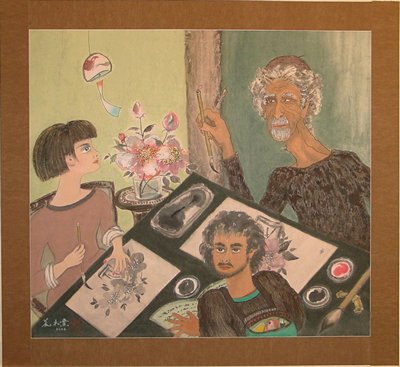
After Araki’s initial encounter with Yao Menggu and Zhang Daqian in Taipei, Taiwan in 1973, the pair introduced Araki to the Taipei art scene. These two men were pivotal in arranging Araki’s earliest exhibitions, which served as the motivation for a particularly prolific period. Between late 1977 and ‘78, he created a startling number of paintings of myriad subjects and in multiple formats, not only the landscapes and lotuses for which he is best known, but also several series of portraits and nudes of men, women, boys, androgynous figures, and birds. His intense focus on these subjects seems to have begun with his chance encounter with a self-portrait by the American artist Ben Shahn (1898–1969), which he first saw when it was shown in Japan in 1970 and of which he later made numerous copies. By spring 1978 his portraits had morphed into a singular fusion of the introspection of Shahn’s figures and the curiously anthropomorphized mynah birds of Bada Shanren conveyed in the swirls, pools, and splashes of Zhang’s splashed-color-and-ink technique. Araki’s figures are aloof and fleeting, lost in themselves but also aware of our presence. Pools of ink, some representational and others seemingly more experimental flicks of the brush, conceal their eyes or blot out parts of their faces. Rather than emerging from the paper, the boys’ and birds’ white faces seem to sink into wet backgrounds of jet black ink that as it pools and bleeds threatens to erase them entirely.