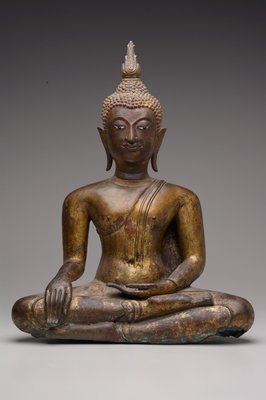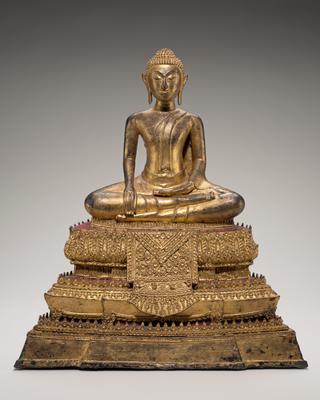
Buddha subduing Mara
- Medium
- Gilt bronze
- Dimensions
- 21 in. (53.3 cm)
- Genre
- Sculpture
Tags
Thailand
About
This depiction of the Buddha, dressed as a prince and seated atop a carpet on an elaborate throne, would become widespread after King Rama I (r. 1782–1809) defeated Burmese incursions and established the Chakri dynasty, which rules present-day Thailand. Its leaders, like many earlier Southeast Asian kingdoms, styled themselves as universal monarchs, or chakravartins, on religious grounds, just as India’s first Buddhist emperor, Ashoka, had done 2, 000 years earlier. Local elites would emulate the opulent royal sculptures for their own aesthetic and spiritual collecting practices. This phenomenon no doubt influenced industrialist Charles L. Freer, who gave this sculpture to Mia in 1917. It is the first work of Asian art to enter the museum’s collection.