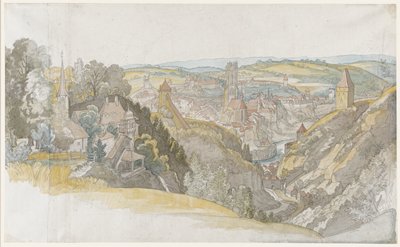
View of the Town of Fribourg
- Medium
- Watercolor, graphite
- Dimensions
- 17 1/4 × 28 3/16 in. (43.82 × 71.6 cm)
- Genre
- Drawings
Tags
Switzerland
About
Georg Ludwig Vogel helped found the Nazarene art movement, which began as a reaction against the Vienna Art Academy. He and others had tired of formulaic training and what they saw as the superficiality of neoclassical art. In 1810 Vogel and three fellow students set off for Rome, where they lived like monks and tried to recover the profound spiritual depth they found in medieval and early Renaissance art. After a few years Vogel returned to his native Switzerland, where he focused on the country’s past glories. In this view of the ancient Swiss town of Fribourg, he concentrated on the town’s Gothic structures, ignoring the architecture that sprang up later. His use of outlines with watercolor washes and his nearly bird’s-eye view recall the landscapes of Albrecht Dürer, one of his artistic heroes, who had flourished three hundred years earlier. Though we may think of Vogel and the Nazarenes as looking backward, their rebellious attitude paved the way for revolutionary artists who would emulate their rejection of academic constraints later in the 1800s.