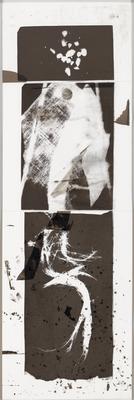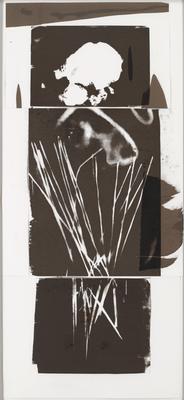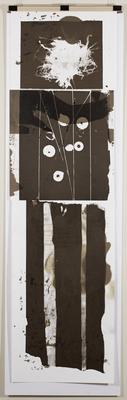
Niet voor Kinderen (9)
Jay Heikes
2015
- Medium
- Screenprinted asphaltum with hand-painted additions in gray-brown asphaltum on paper, triptych
- Dimensions
- 88 9/16 × 25 1/4 in. (224.95 × 64.14 cm)
- Genre
Tags
United States
About
In both concept and method, Jay Heikes’s Niet Voor Kinderen puts a surrealist twist on figurative images composed of found objects. He made the image using the Surrealists’ camera-less photographic technique called a “photogram.” Objects found in the studio are placed on a photosensitive surface and the light is switched on briefly producing eerie silhouettes, partly focused and partly not. The images are broken down into sections—essentially heads, torsos, and legs—which can be recombined. They recall the surrealist parlor game Exquisite Corpse, in which participants collaborate to draw a figure on a sheet of paper folded so that each cannot see what the others have drawn until the image is complete. The image resembles a human or a Frankenstein monster and is not unlike the familiar form of x-rayed mummies. The reference to mummies was intended by the artist. He printed the image using asphaltum in place of ordinary ink. Ancient Egyptians used asphaltum in the preparation of mummies. Moreover, from the 16th to 20th centuries artists used “mummy brown, ” a pigment made from ground up mummies. Continuing work on his image after printing and assembly, Heikes freely painted on it with a wash that resembles this macabre substance.