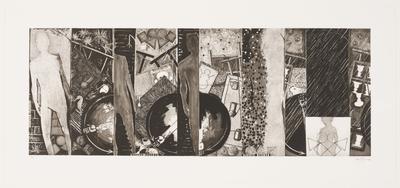
The Seasons
Jasper Johns
1989
- Medium
- Etching and aquatint
- Dimensions
- 19 × 51 1/8 in. (48.26 × 129.86 cm) (plate) 26 3/4 × 58 1/8 in. (67.95 × 147.64 cm) (sheet) 36 1/4 × 68 1/8 × 1 1/4 in. (92.08 × 173.04 × 3.18 cm) (outer frame)
- Genre
Tags
United States
About
For Jasper Johns, the familiar objects and signs of everyday life are ideal subjects for art. It was a radical notion in the mid-1950s, when he and other young artists rejected the emotionally-charged gestural abstraction of the previous generation. Experimenting with mundane subjects such as flags, targets, maps, letters, and numerals, Johns chose these familiar and conventional motifs as a way to negate the expressive or psychological qualities of his subject matter, presenting them as formal and conceptual entities designed to elicit contemplation. In his 1989 print The Seasons, Johns creates an amalgam of symbolic imagery that suggests the experiences and feelings associated with the fleeting change of seasons, corresponding to the rhythm of life.
![Casts (Words) [trial proof 5]](https://api.nga.gov/iiif/a2505dce-5e73-4568-abc1-a8615d473138/full/843,/0/default.jpg)
![Four Panels (DABC) [trial proof 2]](https://api.nga.gov/iiif/cf32b1ff-f381-4a9d-92e5-4f2dd0fd124b/full/843,/0/default.jpg)
![Untitled [monotype]](https://api.nga.gov/iiif/773b22d6-569f-4136-ada8-1c110494759a/full/843,/0/default.jpg)
![Flag and Vase [trial proof]](https://api.nga.gov/iiif/46060b74-9487-4efe-8d13-69c9db469329/full/843,/0/default.jpg)
![Figure 0 [working proof]](https://api.nga.gov/iiif/e70300d7-3e17-422a-94f5-447e90fb23bb/full/843,/0/default.jpg)
![Good Time Charley II [trial proof]](https://api.nga.gov/iiif/3e6a4d51-f16d-42c7-829b-3169b5579d3f/full/843,/0/default.jpg)

![Untitled [Spacing of Plates] [trial proof]](https://api.nga.gov/iiif/3740be7c-9283-4715-9b06-ed3dd618ef4c/full/843,/0/default.jpg)
![The Seasons (Fall) [trial proof]](https://api.nga.gov/iiif/03e60b1e-397d-4f53-a8e8-32799d976aed/full/843,/0/default.jpg)
![The Seasons (Spring) [state proof of 9th state]](https://api.nga.gov/iiif/5f35b2eb-f1e3-4f7e-9cdc-93e4e8d729c4/full/843,/0/default.jpg)
![Figure 7 [progressive proof B]](https://api.nga.gov/iiif/2667270a-d236-4483-b859-a252546e9f80/full/843,/0/default.jpg)
![Untitled (White Mezzotint) [trial proof]](https://api.nga.gov/iiif/3c8b745c-34f6-4472-90a8-e615ee4ae8b1/full/843,/0/default.jpg)