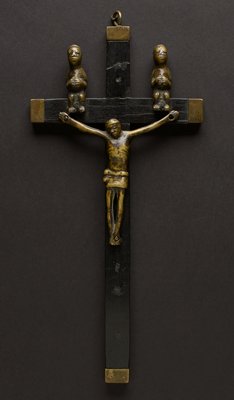
Crucifix
- Medium
- Wood, brass, and iron
- Dimensions
- 12 5/16 × 5 11/16 × 1 in. (31.27 × 14.45 × 2.54 cm)
- Genre
- Sculpture, woodwork
Tags
Democratic Republic of the Congo
About
The Kingdom of Kongo, in central Africa, officially became Christian in the late 1400s, after the baptism of its king. This opened the door to Catholic missionaries, and the Christian ideas and icons that began circulating through the kingdom soon found their way into Kongo art and religious thought. The crucifix was the foremost of these icons, a potent symbol of the new faith that happened to mirror an indigenous cosmogram, a cross-like symbol conveying the Kongo concept of a two-way passage between the world of the living and the world of the dead. These two crucifixes from different centuries were powerful aids to piety and ritual. The oldest example is made entirely of metal, while the other one combines brass and wood. This wood is most likely not original but has been replaced in the past. The small figures in postures of prayer on the cross-bar and the bottom of the crosses are Kongo inventions, possibly representing mourners or ancestors.