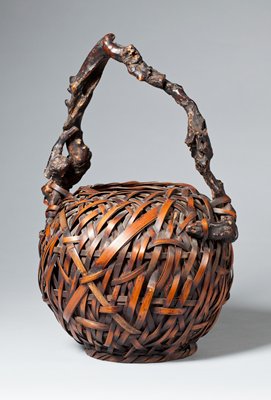
Basket with wood handle
- Medium
- Bamboo and wood
- Dimensions
- 14 7/8 × 9 3/4 × 9 in. (37.78 × 24.77 × 22.86 cm)
- Genre
- Bamboo work
Tags
Japan
About
The Japanese have a long tradition of basket weaving. The earliest extant examples of Japanese baskets date to the 700s and were used at the time in Buddhist rituals to make offerings. Chinese baskets began to be imported in the 1100s, and later became highly coveted as the shoguns and cultural elites began to collect them to use in Japanese tea ceremonies. Bamboo grows abundantly in Japan, and is suitable for weaving because of its strength and pliability. The basketmaker crisscrossed the bamboo strips in a technique called irregular plaiting (midare-ami) to create the circular body of the basket. The wooden handle accentuates the basket’s rusticity, a quality that was appreciated by tea practitioners.

![Netsuke [Frogs on a Leaf]](https://1.api.artsmia.org/31735.jpg)
![Single-line calligraphy [right of a set of three scrolls]](https://1.api.artsmia.org/119363.jpg)
![Netsuke [fox woman]](https://1.api.artsmia.org/30422.jpg)