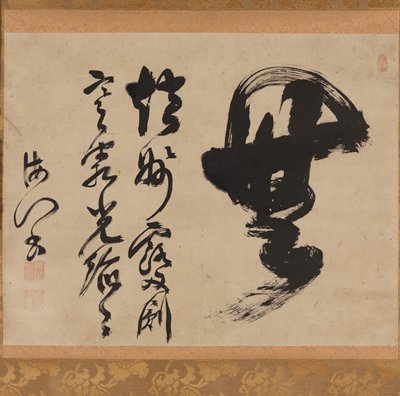
Nothingness (mu)
- Medium
- Hanging scroll, ink on paper
- Dimensions
- 16 5/16 × 20 5/8 in. (41.43 × 52.39 cm) (image) 47 1/4 × 21 1/2 in. (120.02 × 54.61 cm) (mount, without roller )
- Genre
- Calligraphy
Tags
Japan
About
Kaimon, a Zen monk, varies the size of his writing to emphasize the importance of the single character to the right: “mu, ” meaning nothingness, an important concept in Zen Buddhism. The calligraphy traces its origin to the prominent monastic teaching of Zhaozhou Congshen (778-897 ad), a Zen master monk. A fellow monk asks Zhaozhou if a dog has Buddha-nature, to which Zhaozhou replies, “no.” The monk then argues that everything has Buddha-nature. Zhaozhou ends the conversation by pointing out that the dog is misguided by Original Ignorance, implying that the monk himself is the ignorant dog for asking “yes or no” questions. The bold and unbroken brushstrokes render the character compact yet forceful, and creates a form that resembles a seated person in meditation. Kaimon’s writing embodies how the mighty force of Zhaozhou’s “no” shattered the conventional wisdom and helped practitioners polish their mind. 無 趙州露刃劍 寒霜光焰焰 Nothingness Monk Zhaozhou's drawn sword glistens like chilly frost blazing bright